
Thursday, January 16, 2014

Sri Pada

6°48'30" N
21:12 (IST - UTC/GMT+5.5)Sri Pada (Sri Pada) is a mountain (class T - Hypsographic) in (Sabaragamuwa), Sri Lanka (Asia) with the region font code of Asia/Pacific. Its coordinates are 6°48'30" N and 80°29'53" E in DMS (Degrees Minutes Seconds) or 6.80833 and 80.4981 (in decimal degrees). Its UTM position is MN45 and its Joint Operation Graphics reference is NB44-06. 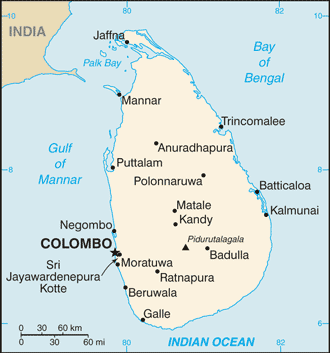 In 2014 DST starts on - and ends on -. A Mountain is an elevation standing high above the surrounding area with small summit area, steep slopes and local relief of 300m or more. |

|
|
Sri Padaya (AdamsPeak) සමනළ කන්ද - SRI LANKA

The mountain is located in the southern reaches of the Central Highlands, in the Ratnapura district of the Sabaragamuwa Province - lying about 40 km northeast of the city of Ratnapura. The surrounding region is largely forested hills, with no mountain of comparable size nearby. The region along the mountain is a wildlife reserve housing many species varying from elephants to leopards, and including many endemic species.
Access to the mountain is possible by 6 trails (Ratnapura-Palabaddala, Hatton-Nallathanni, Kuruwita-Erathna, Murraywatte, Mookuwatte & Malimboda). Out of these the Nallathanni & Palabaddala routes are the most popular. Kuruwita-Erathna road is somewhat popular as well. The other 3 roads are almost obscure. It joins the Palabaddala road midway through the ascent. Buses connect the final nodes of Nallanthanni to Hatton, Palabaddala to Ratnapura & Erathna to Kuruwita. Thereafter it's a difficult journey through the forest on foot. Most of the pilgrims use Hatton route as the journey on foot can be reduced by more than five kilometers even though the slope of this route is much greater than other routes.
Subscribe to:
Posts (Atom)